Blending two cat households into one: introducing groups, not just individuals
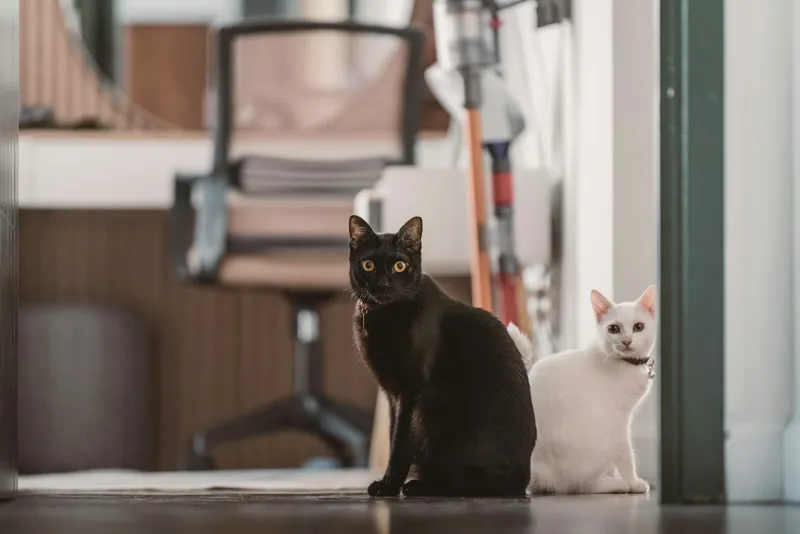
Our guide to introducing cats without a fight and our guide on adding a third cat both assume one thing: a single new cat is joining a household that already exists. Merging two people’s homes into one changes that assumption completely. Two cats who already know and trust each other are meeting two other cats who already know and trust each other, and neither pair is the “resident” side with home-field advantage over a lone newcomer.
Why a group merge isn’t just two individual introductions stacked together
When a single cat joins a household, the existing cats already share settled territory, resource locations, and a social order. A group merge removes that anchor. Both pairs are losing their old home’s layout at the same time, in a lot of cases, since one partner’s place or a new shared home replaces both original spaces. Neither side gets to be the calm, established group welcoming a stranger in. That’s a meaningfully harder starting position than any single-cat introduction, and it’s why the slow, room-by-room pacing in our other introduction guides needs to run for both pairs, not just one direction.
Existing bonds don’t guarantee they’ll stay in sync
A bonded pair who has always shared a home together may not react identically to the other pair. One cat might approach the new arrivals within days while its own housemate stays hidden for weeks. That split isn’t a sign the introduction is failing. It means each cat is working through the change on its own timeline, even when it entered the situation as half of an already-comfortable pair. Watch each cat individually rather than treating either original pair as a single unit that will move through the process together.
Resources need to cover the combined group from day one
Our resource guarding checklist applies here at full scale, not a reduced version of it. With four cats instead of two, litter boxes, food stations, water sources, and rest spots all need to multiply to match the new total, not the count either original household used to get by on. Setting up for the combined group before the first supervised meeting, rather than adding resources reactively once tension shows up, avoids competition that has nothing to do with how well the cats are actually getting along.
Give the new home neutral footing before any introductions start
If one partner’s existing home becomes the shared space, that home isn’t neutral to the arriving pair, and it isn’t fully neutral to the resident pair anymore either once new cats’ scent starts showing up in it. Where possible, rearrange furniture, add new resting spots, and let scent-swapping (a step covered in our introducing cats guide) happen across the whole shared space before anyone shares a room. A completely new, shared address for everyone removes the home-field problem entirely, but that’s not always realistic, so treating an existing home as needing its own re-neutralizing step is the next best option.
Sequence the calmest cats first, not the whole groups at once
Introducing all four cats in one shared space on day one multiplies the number of individual relationships that can go wrong at the same time. A steadier approach pairs off the most confident cat from each side first, following the same slow visual and scent introduction steps used for any two-cat introduction, before bringing in the more cautious cats from either household. Reading body language for hidden tension matters more here than in a single-cat introduction, since four cats generate four times the individual signals to track across every session.
Watch for redirected aggression pulling in cats who never actually met
A tense encounter between one cat from each side can spike arousal in a housemate who wasn’t even part of the interaction. Our guide to redirected aggression covers why that spillover happens. It can hit a bonded pair particularly hard, since two cats who trust each other completely can still redirect a bad moment onto one another after a stressful encounter with the new group.
Not every four-cat household ends up fully bonded, and that’s fine
Some merged households end up with four cats who all get along. Plenty of others settle into two pairs who coexist in the same space without ever crossing into a single bonded group of four. Our guide on cats that never fully bond covers how to tell a genuine stable plateau from a merge that’s still working itself out. A group merge is exactly the situation where settling for calm coexistence between two established pairs is often the realistic, perfectly livable outcome, instead of holding out for one big happy household.