When cats never fully bond: managing a household where cats coexist instead of become friends
Our slower introduction guide and decision guide on separation both assume the goal is eventually getting cats to a comfortable shared life, and usually that’s the right assumption. But a real share of multi-cat households do everything the guides recommend and still end up with two cats who tolerate each other at a distance and nothing more. That’s not always a failure to fix. Sometimes it’s the actual, stable answer, and treating it as a still-in-progress introduction months or years past the point of change is what keeps a household stressed instead of settled.
Tolerating and bonding are different outcomes, not two points on the same scale
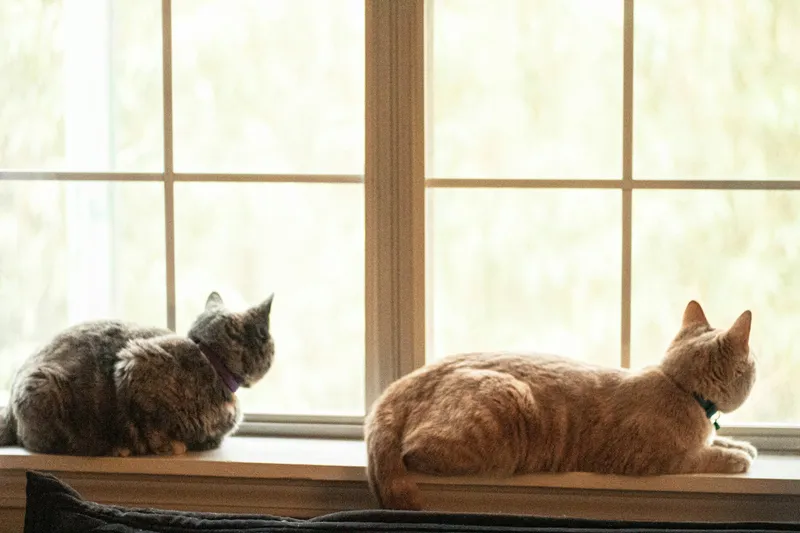
A bonded pair grooms each other, sleeps touching, and greets each other with a raised, relaxed tail when they meet. A pair that’s merely tolerating each other can share a house indefinitely without ever doing any of that. They eat in the same room without stealing from each other’s bowl, pass in a hallway without a hiss, and rest in the same general area while facing away, like two cats sharing a windowsill without acknowledging one another. No active conflict. No affection either. Both are normal, livable outcomes. The mistake is assuming the second one is just the first one still developing.
How to tell a plateau from early progress
Early in an introduction, distance shrinks over weeks. Cats that started on opposite ends of the house begin sharing a room, then a piece of furniture, then closer proximity within that furniture. If that trend has genuinely stalled, the same distance, the same wary body language on accidental encounters, for two or three months straight with no slow narrowing, that’s a plateau, not a slow version of the same process. Our guide to reading tension before it becomes a fight is useful here specifically because a plateaued pair often shows low-grade tension signals (a fixed stare, a flattened ear) on every pass, not just occasionally. If those signals haven’t softened in months, more reintroduction sessions are unlikely to be the missing piece.
Redesigning resources for permanent parallel access
Our resource guarding checklist treats duplicated food, water, litter, and rest spots as a way to reduce competition during an active introduction. For a household settling into permanent parallel living, that duplication becomes the long-term floor plan rather than a temporary measure. Each cat gets a fully separate set of resources in a separate zone, connected by shared hallways or open areas rather than a single shared room. A microchip cat door or a timed gate schedule can let each cat access a favorite space on its own hours instead of forcing simultaneous use. The goal shifts from merging two territories into one to keeping two territories comfortably adjacent.
Vertical space does double duty here
Vertical territory matters even more in a parallel-living household, because height gives each cat a route through shared areas that doesn’t require passing close on the floor. A cat tree near a doorway, or a shelf that runs along a wall above head height, lets one cat cross a room the other is using without either needing to yield ground at close range. That’s a meaningful difference between a tense pass and a comfortable one.
Why pushing for more contact usually backfires
It’s tempting to read a stable, low-conflict plateau as readiness for the next step, closer proximity, a supervised play session, feeding side by side. If the underlying wariness hasn’t actually resolved, forcing closer contact tends to produce a bad interaction that both cats remember, which can set back even the calm distance they’d settled into. A stable plateau without conflict is a genuinely good outcome. It doesn’t need to be treated as a stepping stone to something more if the cats themselves aren’t showing signs of wanting it.
When it’s not actually a stable plateau
Not every non-bonded pair is fine as is. Watch for a difference between calm avoidance and a cat that’s actually suffering under it: persistent hiding well beyond normal cat napping, appetite changes, weight loss, or overgrooming concentrated in one cat rather than both. Those point toward chronic stress rather than a comfortable arrangement, and they’re a reason to bring in a vet behaviorist rather than assume more time alone will resolve it. A genuinely stable parallel household has two cats who look bored or indifferent around each other. It doesn’t have one cat who looks afraid.