Reading cat body language for hidden tension before it becomes a fight
By the time two cats are hissing or swatting, the conflict has usually been building for days or weeks in a form that didn’t look like fighting at all. Cats communicate most of their social standing through posture, positioning, and eye contact long before anything escalates to contact. Learning to read that layer catches tension while a quick fix (an extra resource, more distance, a schedule change) still works, instead of only noticing once you’re managing an active conflict.
The stare that isn’t just looking
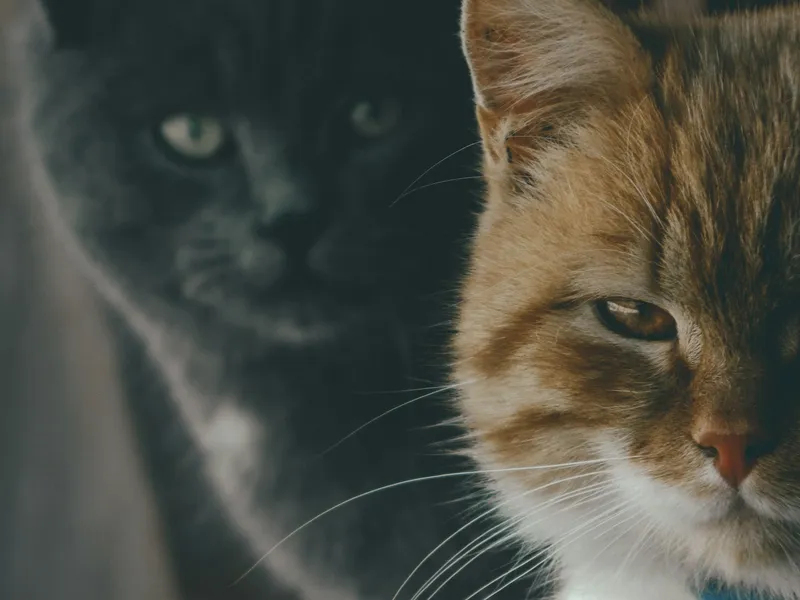
A cat glancing at another cat is normal. A cat holding a fixed, unblinking stare at another cat across a room, especially combined with a lowered head and stiff posture, is a threat display, not curiosity. The staring cat is usually claiming something, a doorway, a piece of furniture, a path to the litter box, and the other cat’s response tells you whether it’s working. If the stared-at cat freezes, looks away, or leaves the area, the stare has already done its job without a single sound.
Blocking is a weapon that looks like sitting still
A cat lying in a hallway, on a stair landing, or in front of a doorway isn’t necessarily just choosing a comfortable spot. If another cat consistently changes its route, waits, or turns back rather than walking past that spot, the first cat is controlling territory just by occupying it. This is easy to miss because nothing about it looks aggressive, there’s no posturing, no sound, just one cat that happens to nap in exactly the right chokepoint, over and over.
Watch what a cat stops doing, not just what it starts doing
Active aggression gets noticed. A cat that quietly stops using a specific litter box, stops sleeping on a particular windowsill, or starts eating faster and looking up between bites rarely gets flagged the same way, even though it’s often the clearer signal. Our resource guarding checklist covers walking the house resource by resource; this is the behavioral side of the same problem, the withdrawal that shows up before or instead of a visible confrontation.
Tail and ear position at a distance
A tail held low and flicking, or ears rotated sideways and back, while a cat is simply sitting near another cat, is worth watching even with no other behavior around it. That’s not the same as ears flattened all the way down, which signals fear rather than tension. These are more reliable early signals than vocalizing, because a cat that’s already growling or yowling has usually moved past the stage where a quiet intervention still helps.
What to actually do when you spot it
Catching this stage doesn’t call for full separation the way an active fight does, see our decision guide on how much separation fighting cats actually need for that threshold. At the staring-and-blocking stage, the more useful move is removing the specific chokepoint: add a second path around the blocked spot, or add a duplicate resource so the standoff has nothing to stand off over. Or simply interrupt a held stare with a toy or treat before it resolves into contact. If the pattern keeps recurring around the same one or two spots despite changes, that repetition is itself useful information for figuring out why the tension started in the first place.
When quiet tension is actually the bigger problem
A household running on this kind of quiet standoff doesn’t always look urgent, and it’s genuinely easy to let it continue for months because nothing dramatic ever happens. But a cat that’s spent months losing every quiet negotiation is under real chronic stress even without a single audible fight, and that stress shows up elsewhere: coat condition, appetite, litter box habits. If the checklist above turns up a consistent pattern where one cat always yields and one cat always claims, that’s worth treating with the same seriousness as an active conflict, not less, just because it’s quiet.