The predatory play sequence: why your cat's toys stop working
A new toy usually gets a burst of interest and then fades within a week or two, and the default explanation is that the cat got bored of it. That’s sometimes true, but it skips a more specific and more fixable reason: most toys are built around one piece of a four-part hunting sequence, and a cat that can’t complete the sequence eventually stops bothering to start it.
The four parts cats are actually wired for
Domestic cats retain the same hunting sequence as their wild relatives: stalk, chase, pounce, and bite. Each phase has its own posture and its own trigger. Stalking is slow, low, and quiet, with the cat’s weight staying back. Chasing is a burst of fast, direct motion toward something moving away. Pouncing is the leap, usually preceded by a wiggle of the hindquarters. The bite, on a real prey animal, is the part that ends the sequence, and it’s also the part most toys skip entirely.
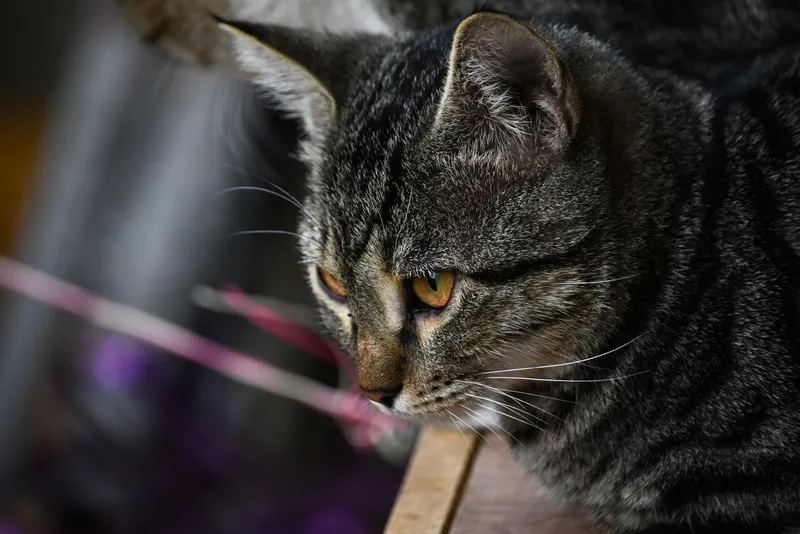
The stalk: low body, slow approach, eyes locked forward. This is the phase most toys skip straight past.
Why a laser pointer is the clearest example of the problem
A laser dot is excellent at triggering the stalk and chase phases and can’t deliver the pounce or the bite at all, since there’s nothing physical to land on or grab. Cats that only ever play with a laser can end up in a loop of chasing without ever getting a resolution, and some develop visible frustration around it: pacing, fixating on the spot after the light turns off. Others lose interest faster each session because the payoff never comes. A laser isn’t a bad toy on its own, but it shouldn’t be the only toy in rotation, and a session with one should end by switching to something a cat can actually catch.
A laser covers three of the four stages and then simply stops. Landing the dot on a physical toy at the end of a session, or following it with a treat, gives the cat the catch the sequence is asking for.
Match the toy to the phase, then chain them together
A single session works better when it moves a cat through more than one phase instead of repeating the same motion for ten minutes. A wand toy dragged slowly along the floor and behind furniture triggers the stalk. Speeding it up into open space triggers the chase. Letting it “tire out” and slow down near the end gives the cat an opening to pounce. Finishing with something that can be gripped, kicked with the back feet, and actually bitten (a stuffed toy, a catnip mouse, a treat hidden inside a toy) closes out the bite phase. A bare wand or a laser can’t provide that.
A tunnel or box adds the stalking cover a flat floor doesn’t
Open floor space works against the stalk phase, since there’s nowhere to crouch out of sight before a chase starts. Furniture to duck behind, or a dedicated tunnel like the ones in our cat tunnel roundup, gives a cat a place to disappear into and reappear from. That’s closer to how the stalk phase actually works than a toy sitting alone in an empty room.
Ending a session without a “kill” leaves a cat wound up, not satisfied
A play session that stops abruptly after the chase, the human puts the wand toy away and walks off, doesn’t give a cat the physiological wind-down that finishing the sequence provides. That mismatch is part of why some cats seem more amped up after play instead of calmer. Closing every session with a catchable toy and a small treat afterward mimics the eat-groom-rest pattern that follows a real catch, and tends to leave a cat settled instead of still keyed up.
If toys stop working even with a full sequence
Cycling through the full stalk-chase-pounce-bite pattern and still getting a flat response points somewhere other than the toy. Our guide on indoor cat enrichment on a budget covers the non-toy side of enrichment. If a cat seems more withdrawn than uninterested, it’s worth checking the signs that separate boredom from stress before assuming the fix is another toy.