Excessive meowing in cats: when a vocal cat is actually a stressed cat
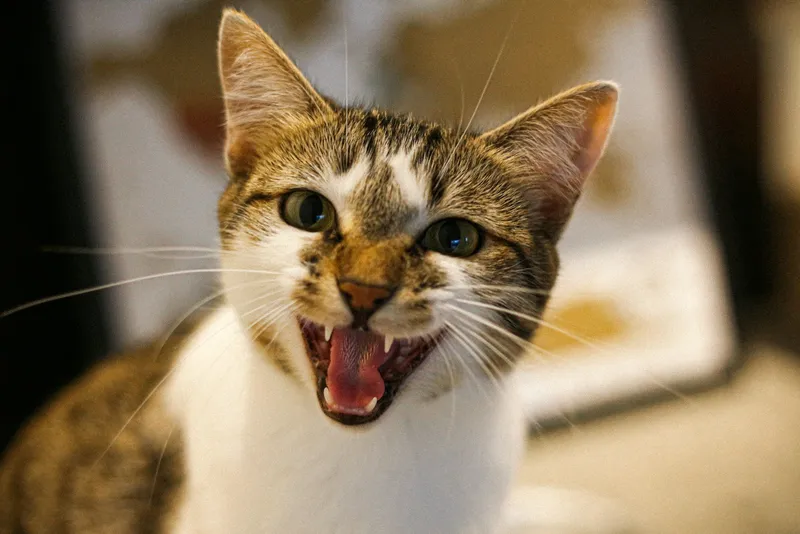
Some cats narrate their whole day. A Siamese greeting you at the door, a cat asking for dinner ten minutes early, a running commentary on the birds outside: none of that is a problem on its own. Our guide on reading stress signs mentions increased vocalization in a single line. This one looks at what actually separates a chatty personality from a cat trying to tell you something is wrong.
What counts as normal talking
Volume and frequency vary enormously by breed and by individual cat. Some breeds, Siamese and other Oriental lines especially, are bred partly for being loud and stay that way their whole lives. A cat that has always meowed at the fridge door or narrated its way around the house isn’t showing a new problem. That’s just who it is.
The useful question isn’t “is this cat loud.” It’s “did this cat’s baseline change.” A quiet cat that suddenly starts meowing at 3am is a bigger signal than a naturally vocal cat doing what it always does.
When it’s a stress signal instead
A few patterns point toward stress rather than personality:
- A clear increase from that specific cat’s own baseline, not just “loud in general”
- New vocalizing tied to a specific trigger: a recent move, a new pet, a schedule change
- Meowing that shows up alongside other stress signs like hiding, overgrooming, or appetite changes
- Yowling that happens in specific locations, like near a closed door or a window facing outside
None of these alone means an emergency. Together, especially if they started around a known change in the house, they’re worth treating as communication rather than noise.
Night yowling deserves its own look
Vocalizing that’s worse at night, especially in an older cat, isn’t automatically a stress issue. Feline cognitive dysfunction, similar in some ways to dementia, causes disoriented yowling in senior cats, often loudest in a quiet, dark house where there’s nothing to distract from confusion. Hyperthyroidism is another common cause of sudden vocalization increases in cats over ten, usually paired with weight loss despite a bigger appetite.
Both of those are medical, not behavioral, and both need a vet visit rather than an environmental fix. Our guide on telling anxiety from pain covers how mixed presentations like this get sorted out.
What actually helps
Start by identifying the trigger rather than the meowing itself. A cat yowling at a closed door wants access to something behind it. A cat crying at feeding time wants the schedule addressed directly, not the sound suppressed. Treating the cause tends to reduce the vocalizing as a side effect, faster than trying to train the sound away on its own.
Add a consistent play session before the times vocalizing tends to spike, especially early morning or late evening. A cat that’s genuinely tired sleeps through the hours it would otherwise spend calling for attention. Keeping a home-alone cat entertained covers structuring the day around that.
Don’t reward the exact moment a cat is yowling with attention, food, or play, even accidentally. A cat that learns yowling reliably produces a response will keep using it, which doesn’t mean the original stress wasn’t real. It means the fix now has two parts: addressing the stressor, and not accidentally training the behavior to continue after the stressor is gone.
When to call a vet
A sudden increase in vocalization, especially in a cat over ten or one that previously wasn’t loud, is worth a vet visit before anything else. Hyperthyroidism and cognitive decline are both common, both treatable to some degree, and both easy to mistake for a purely behavioral problem if nobody checks bloodwork first. Our guide on when to call a vet behaviorist covers how to draw that line more generally.