Clicker training for cats: a beginner's guide to enrichment through learning
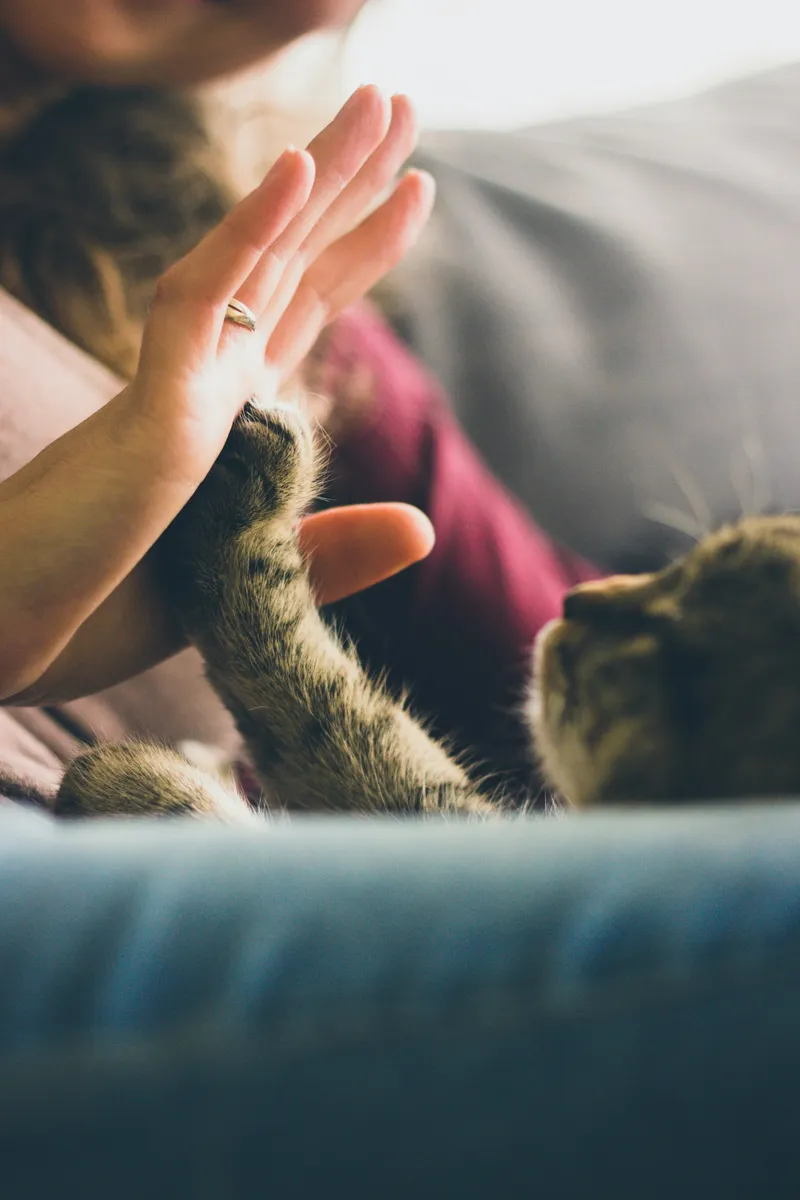
Most of what gets called “enrichment” for cats is a toy, a scent, or a piece of furniture: something a cat interacts with mostly on its own. Clicker training is a different kind of mental work entirely. It’s a short, structured back-and-forth between a cat and a person, where the cat has to notice what it just did, connect that to a sound, and figure out what to repeat to make the sound happen again. That figuring-out is the enrichment. The trick itself, sit, target, spin, whatever it ends up being, is almost beside the point.
What a clicker actually does
A clicker is a small plastic device that makes one sharp, consistent sound. On its own it means nothing to a cat. What makes it useful is a short pairing process. Click, then immediately give a treat, repeated ten or so times in a row with no task attached, until the cat reliably looks toward you or the treat the instant it hears the click. Once that association is set, the click becomes a precise marker you can fire the exact moment a cat does something you want, even if the treat itself takes a second longer to reach its mouth. That precision is the entire advantage over just saying “good cat” and handing over a treat: a click can mark a single instant, a verbal cue can’t be timed nearly as tightly.
Target training is the easiest place to start
The most beginner-friendly first behavior isn’t sit or come, it’s targeting: teaching a cat to touch its nose to the tip of a target stick (a chopstick or a pen works fine) or to a person’s fingertip. Hold the target a few inches from the cat’s face. Most cats will investigate it out of curiosity, sniffing or bumping it with their nose. The instant that happens, click and treat. Repeat, moving the target slightly farther or to a different angle each time. Within a handful of short sessions, most cats start deliberately walking toward and touching the target rather than just stumbling into it, which is the first real “aha” moment that the click means something.
Sessions should be short and end on a win
Two to five minutes is a realistic session length, not twenty. Cats lose focus faster than dogs typically do in this kind of structured task, and pushing past that point tends to produce a cat that wanders off rather than one that’s still learning. End each session on something the cat just got right, even if that means going back to an easier version of the behavior for the last rep, rather than stopping mid-struggle. A session that closes on a win is part of why the cat comes back curious for the next one instead of avoiding it.
Food-motivated cats learn faster, but low interest isn’t a dead end
A cat that’s food-motivated will pick this up faster simply because the reward lands harder. A cat that’s less interested in treats can still be trained using a favorite toy, a few seconds of a preferred kind of petting, or access to something it wants (a doorway, a lap) instead of food. The click just needs to predict something the individual cat actually values. What doesn’t work well is training right after a full meal, when even a food-motivated cat has little reason to work for a treat. A session before a meal, when a cat is a little hungry but not desperate, tends to go better than one right after.
This is a different channel than toy or scent enrichment
Our predatory play sequence guide covers why toys stop working when they don’t complete a full hunting sequence, and toy or scent enrichment generally works by triggering an instinct a cat already has. Clicker training works through a different mechanism: operant learning, where the cat is actively testing cause and effect rather than reacting to a trigger. A cat that’s already well covered on toys, scratching outlets, and scent enrichment can still be understimulated in this specific way. None of those ask a cat to solve a “what earns the click” problem the way training does.
When training stalls, it’s usually the timing, not the cat
The most common reason a cat seems “impossible to train” is late or inconsistent clicking, marking a moment a beat after the behavior actually happened rather than the instant it happened, which teaches the wrong thing without anyone noticing. If sessions consistently go nowhere, it’s worth filming one and reviewing the click timing before concluding a particular cat just isn’t a training candidate. And if a cat that used to engage with sessions suddenly won’t, refuses treats it normally wants, or seems flat rather than just disinterested, that’s worth noticing. Check it against our guide on reading your cat’s stress signals before assuming it’s a training problem at all.