Sleepypod Air review: worth it if your cat panics in the carrier
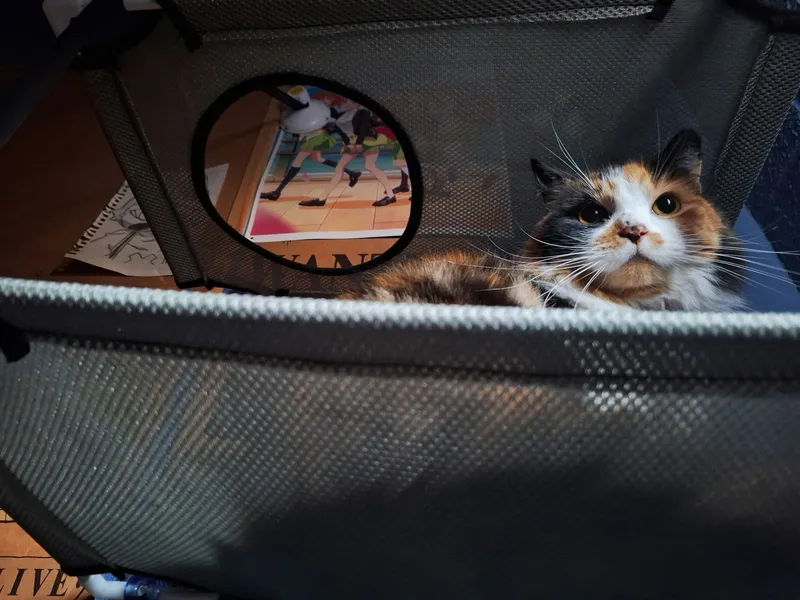
Our take
Expensive, and the multi-side opening genuinely changes how a frightened cat can be handled. The rated crash testing is the part that actually justifies the price.
Check price at AmazonDisclosure: This post contains affiliate links. As an Amazon Associate, we earn from qualifying purchases at no extra cost to you. See our full affiliate disclosure.
The Sleepypod Air costs about four times what a competent hard-sided carrier costs, so the question is narrow: does the money buy function, or finish? For a cat that strolls into a plastic box on its own, it buys finish. For a cat that has to be wrestled in and poured out at the vet, and for anyone driving with a cat regularly, there are two features here that genuinely aren’t available cheaply.
The opening design is the headline feature
Most carriers give you one door on the short end. That geometry forces the two worst possible manoeuvres: pushing a resisting cat forward into a dark tube, or reaching into the back of that tube to drag out a cat who has braced against the far wall. Both teach the cat that the carrier is where bad things start.
The Air unzips flat and also opens from the top and one end. The useful consequence is that you can lower a cat straight down into it, which is a fundamentally different action from pushing one forward. Cats resist forward pressure into an enclosed space far more than they resist being set down. At the vet, the same feature means the top can come off and the cat can be examined sitting in the base rather than being extracted at all, which many veterinary staff will do if you offer it.
The complaint that undercuts it
The soft sides do not stand up on their own, so loading the cat from above realistically takes two people. Two hands holding the carrier open, two hands managing the cat.
That’s a fair hit and worth planning around, because it partly undermines the main selling point for anyone handling a cat alone. In practice the workarounds are to load it inside a closed room with the carrier braced against a wall or in a corner. Another option is to seat the carrier in a box or on a chair so the sides are supported. If you’re frequently loading a difficult cat by yourself with no one to help, a top-loading hard carrier solves the same problem for a fifth of the price. That comes at the cost of the crash rating and the flat-open access.
The safety case is the strongest argument, and it’s not on the box
The Air is certified by the Center for Pet Safety, an independent non-profit that crash tests pet restraints using child-seat-derived protocols. It holds a 4-star rating, certified for pets up to 18 pounds. CPS issues three outcomes, five stars, four stars, or not recommended, so this is the second of two passing grades rather than the top one.
The context matters more than the star count. Sleepypod was the first manufacturer to earn any CPS carrier certification at all, in 2016, and the overwhelming majority of carriers sold have never been tested to any published standard. “Crash tested” appears on plenty of packaging with no verifiable protocol behind it, which is precisely why an independent certification is worth something.
If the carrier is going to spend its life belted into a car, this is the part of the price that’s buying something you can’t get for forty dollars. If the carrier is going to be carried on foot to a clinic three blocks away, it’s buying you very little.
How much the reputation is worth
This carrier is well regarded, and it is worth being clear about the limits of that. It’s a niche premium product bought deliberately by owners who already decided the problem was worth solving, so the people reporting back are a friendlier group than the ones who buy whatever carrier the pet store had. There is also far less of a track record than a mass-market carrier accumulates. Treat its reputation as encouraging rather than as proof of durability across years.
The crash certification in the section above is the one claim here that comes from an independent test rather than from owner enthusiasm, which is why we weight it more heavily than anything else in this review.
Who this is wrong for
Skip it if your cat already walks into a standard carrier and comes out without a fight. You would be paying a large premium for a problem you don’t have. The money is better spent on pheromone spray for the carrier interior and a few weeks of leaving the existing carrier open in the living room.
Skip it if the carrier never goes in a car. The crash rating is the single best justification for the price, and it’s worth nothing on foot or in a taxi where the carrier sits on a lap.
Skip it if you handle a difficult cat alone and can’t brace the carrier, per the complaint above. A rigid top-opening carrier is the better ergonomic answer for solo loading.
Skip it if you need something that folds away small. This holds its shape by design, which is exactly why it’s stable in transit and exactly why it’s awkward in a closet.
The carrier isn’t the whole problem
No carrier fixes carrier anxiety by itself. A cat that only sees the carrier on vet days learns what it means, and the best carrier in the world still triggers that association. The fix is leaving it out permanently with a familiar blanket in it, feeding near it, then in it, so it becomes furniture rather than an omen. Our travel carrier roundup compares the alternatives at other price points, and vet visit anxiety covers the desensitising routine that matters more than the hardware.
Bottom line
Buy it if a cat rides in a car regularly and getting them in or out is currently a two-person struggle: you’re buying independently verified crash safety plus an opening design that removes the worst part of handling. Skip it if the cat is already fine with a carrier, if it never sees a car, or if you need to load a fighting cat alone with nothing to brace against.
What we liked
- Opens flat and from the top, side, and end, so you never have to force a scared cat through one small door
- Center for Pet Safety certified at 4 stars for pets up to 18 lbs, an independent crash-test standard almost no carrier at any price has passed
- The top comes off, so a vet can examine the cat sitting in the base instead of extracting it first
- Fits under most airline seats, useful if a move involves flying
- Padded, low platform inside reduces the sliding that spikes anxiety in transit
What we didn't
- Roughly four to five times the price of a competent hard carrier
- Soft sides don't hold themselves open, so top-loading a cat solo is harder than it sounds
- Bulkier to store than a collapsible soft carrier
- A niche premium product, so there is far less long-term durability evidence than for mass-market carriers
- The FAA-compliant tether is irrelevant if you never fly