Go Cat Da Bird Single Pole Teaser review: why a plain feather wand still out-hunts most electronic toys
Our take
A pull-apart fiberglass rod and a cluster of real guinea fowl feathers that spin and flutter when swung. It's not a novel piece of engineering. It wins on motion, not features, and that's exactly what most bored cats respond to.
Check price at AmazonDisclosure: This post contains affiliate links. As an Amazon Associate, we earn from qualifying purchases at no extra cost to you. See our full affiliate disclosure.
The Da Bird is about as simple as a cat toy gets: a fiberglass rod, a length of string, and a cluster of real guinea fowl feathers tied to a swivel at the end. There’s no battery, no sensor, no app. The whole toy is built around one idea. A swivel-mounted feather cluster spins and flutters when it’s pulled through the air. That motion is close enough to an actual bird in flight that it gets a reaction from cats who’ve gone flat on everything else in the toy box.
It already shows up as one pick in our roundup of wand and teaser toys for completing the predatory play sequence. This review goes deeper into that single product: what the spinning motion is actually doing, and where a decades-old design still holds up against newer electronic competitors.
The swivel is the whole trick
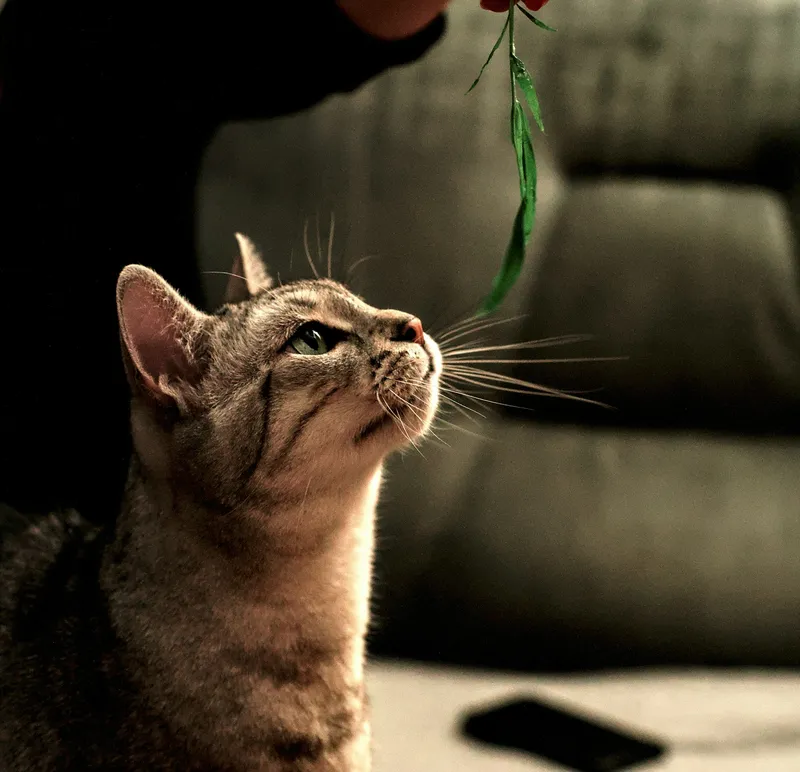
Most wand toys attach a fixed lure to the end of a string. Da Bird’s feather cluster is mounted on a swivel instead, so it spins independently of how the rod itself is moving. Drag it flat across the floor and it skims. Snap the rod upward and it flutters and turns unpredictably, the same erratic motion a real bird makes trying to escape. That unpredictability is the reason a stiff, single-direction toy loses a cat’s attention fast while this one doesn’t.
The rod itself pulls apart into two pieces for storage. That matters more than it sounds like it should. A wand toy left out between sessions turns into background furniture within a week, the same problem our indoor enrichment on a budget guide covers for the rest of a toy collection.
Real feathers versus synthetic ones
Go Cat uses actual guinea fowl feathers rather than dyed synthetic fiber or fabric ribbon. The texture and the way real feathers catch air are part of why this toy reads as more convincingly bird-like than a lot of the synthetic wands sold alongside it. The tradeoff is durability: feathers fray and shed with regular biting and clawing, and the cluster needs replacing every so often rather than lasting indefinitely.
Go Cat sells the feather refills separately, so a worn-out end doesn’t mean replacing the whole rod. That’s a meaningfully different cost structure than a toy where the whole thing gets thrown out once one part fails.
What it can’t do that a battery-powered toy can
A Da Bird session requires a person holding the other end of the rod, every time. There’s no version of this toy that runs on its own while a cat is home alone all day, which is exactly the gap our Cheerble Wicked Mouse review covers from the other direction. That’s not a flaw so much as a different job. A hands-on wand toy lets a person control pace directly, slowing down to build a stalk and speeding up right before a pounce, in a way no self-propelled toy can currently match.
Storage and safety are not optional
The string, the swivel, and the feather cluster are all things a cat can get tangled in or bite pieces off of if the toy is left within reach unsupervised. This toy is meant to come out for an active session and go away afterward, not sit in a basket on the floor between uses. That storage step is part of using it safely, not an inconvenience layered on top.
Who this is wrong for
Skip it if daily supervision during play isn’t realistic. A string-and-feather toy needs to be put away between sessions, and that upkeep is part of the deal.
Skip it if a cat has already shown no interest in feather-based toys specifically. Some cats respond much more to ribbon, fur, or crinkle materials, and no amount of swivel motion changes that preference.
Skip it if the goal is something that plays with a cat while nobody’s home. This is strictly a hands-on toy, and a solo option like a robot mouse or an automatic wand base fills that gap instead.
Bottom line
Buy it for the actual play session, the ten minutes a day where a person is holding the rod and running a cat through a real stalk-chase-pounce sequence. Don’t expect it to entertain a cat unsupervised, and budget for the occasional feather refill once the original cluster gets shredded. It’s a genuinely simple toy, and that simplicity is most of why it still works.
What we liked
- Genuine feathers spin and flutter erratically in a way most synthetic wand toys can't quite copy
- Feather cluster is replaceable, so a shredded end doesn't mean buying a whole new toy
- Rod pulls apart into two pieces for storage, useful if wands need to stay out of sight between sessions
- Cheap enough that a scratched cord or a lost feather refill isn't a real financial loss
- Long track record. It's been a standard vet-recommended pick for years, not a new product with no history
What we didn't
- It's a hands-on toy. It does nothing while nobody's holding the rod, unlike a battery-powered option
- Feathers wear out with regular use and need replacing, an ongoing small cost the toy itself doesn't have
- The string and swivel are a real strangulation and ingestion risk if left within reach, so it has to be put away every time
- A handful of other Go Cat and GoCat listings (different bird counts, pull-apart vs one-piece rods) show up in the same search, so it's worth confirming the exact listing before buying
- Some cats do lose interest in feathers specifically even when they respond to everything else about wand play