SureFlap Microchip Cat Flap review: what a chip-reading door actually solves
Our take
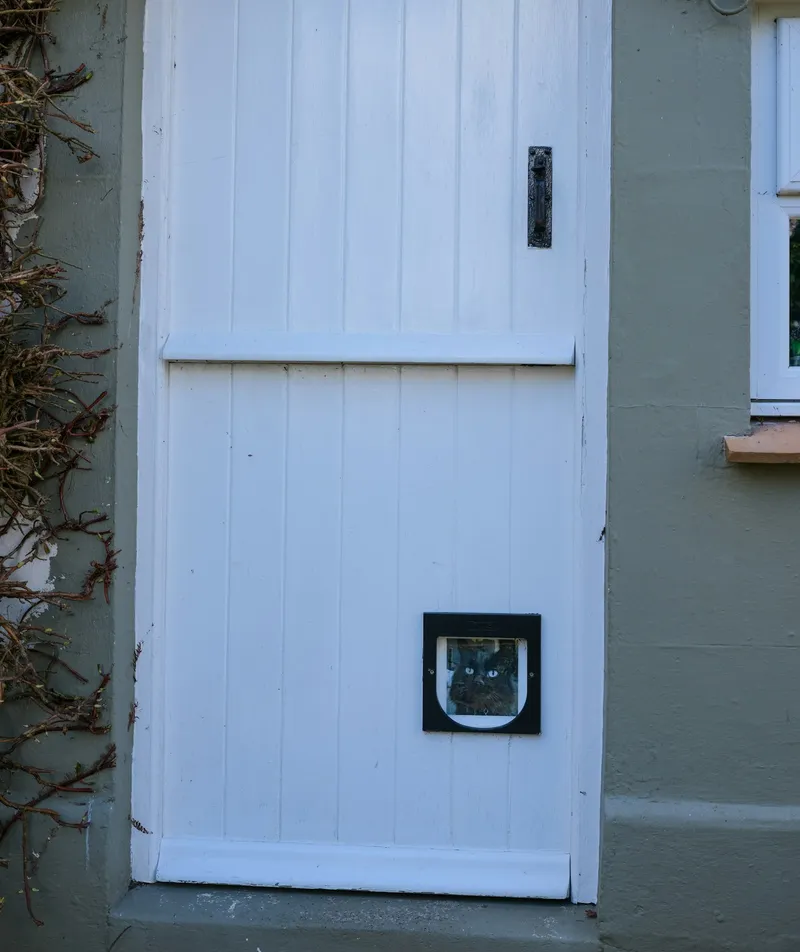
It reads a cat's own microchip to release a magnetic lock, so a specific room stays off-limits to every cat except the ones you've stored, up to 32. The real tradeoffs are tailgating and a base model that doesn't do remote monitoring.
Check price at AmazonDisclosure: This post contains affiliate links. As an Amazon Associate, we earn from qualifying purchases at no extra cost to you. See our full affiliate disclosure.
Our microchip cat doors roundup covers this flap as one option among several. It’s worth a closer look on its own. “Reads a chip and opens a door” undersells what one-way locking and the 32-pet memory actually let you do, and it also undersells a couple of real gaps in the mechanism.
How the chip reading and locking actually work
A sensor built into the flap frame scans for a cat’s implanted ISO microchip as it approaches, the same code a vet’s handheld scanner reads. It handles the 9, 10 and 15 digit formats. If that code is one of the up to 32 you’ve stored, a magnetic catch releases and the flap swings open. Anything else, human hand included, gets a locked door.
There’s no camera and no decision-making beyond that single check. The flap either recognizes the chip or it doesn’t, which is exactly why it’s useful for keeping one specific cat out of a specific room without anyone standing there to police it.
Why locking only one way is the right design for a shared home
The reader sits on the outside of the flap only. A cat is checked on the way in, and any animal can push its way out without a scan.
That sounds like a gap. In a multi-cat home it’s usually the point. Say the flap guards a quiet room with a litter box or a food station for a cat who gets bullied. That cat can always leave. If a stronger cat does slip in behind it, the lower-ranking cat isn’t cornered in a small room with no exit.
There’s no schedule or timer on this base model. It recognizes a chip or it doesn’t, around the clock.
What “Connect” is, and isn’t
SureFlap also sells a model called Microchip Cat Flap Connect, and it’s easy to assume that’s an add-on hub for this flap. It isn’t. Connect is a separate product with its own SKU, paired with a hub that adds Wi-Fi, an activity log, and remote locking through a phone app. The base flap reviewed here has none of that. If a usage log or app control matters to you, that’s a different purchase, not an accessory for this one.
The two gaps worth knowing before you install one
The flap only checks a chip on the way in, so a second cat standing close behind the recognized one can sometimes slip through before the flap swings shut. That’s the same tailgating risk that shows up with other single-scan microchip doors. It isn’t a guaranteed barrier against a determined cat that’s learned to time its approach.
The flap can also fail to fully reclose in a strong draft or wind, which can leave it sitting unlatched rather than locked. Neither issue makes the flap useless, but both matter more if the cat you’re keeping out is especially persistent. In that case, a solid gate might be the more complete tool, even though it blocks every cat rather than just the wrong one.
Who this is wrong for
Skip it if the cat you need to control isn’t chipped and won’t reliably wear a compatible RFID collar tag. The whole mechanism depends on something being read at the door.
Skip it if you need per-direction control, keeping one cat inside a room while others pass freely, or the reverse. This base flap only scans on entry. SureFlap’s DualScan model, covered in our roundup, checks both sides.
Skip it if remote monitoring or a phone alert matters to you. That’s the Connect line, not this flap, and buying this one expecting app features later means buying a second product.
Bottom line
This is a solid, low-maintenance fix for one specific problem: keeping every cat except one or two out of a room, permanently, without a person managing a gate. The 32-pet memory covers almost any household, and a cat inside can always get out. Just don’t expect it to catch a fast, motivated second cat every single time, and don’t expect app control out of the box. Our guide on how much separation fighting cats actually need is worth reading first if you’re not yet sure a permanent door, rather than a temporary gate, is the right call.
What we liked
- Uses the cat's existing microchip, so a chipped cat needs no extra collar or tag to be recognized
- Stores up to 32 pet IDs, more than enough headroom for almost any home
- Scans on the way in only, so any cat already inside can always leave and nobody gets trapped
- Runs on four AA batteries with no wiring, and a red light warns before they run out
- Separate mounting kits exist for walls and glass if the flap isn't going in a door
What we didn't
- No app, remote lock, or activity log on this base model. That's a different product, SureFlap Connect, with its own hub
- A second, unregistered cat can slip through right behind the recognized one before the flap relocks
- The flap doesn't always swing fully shut in wind, which can leave it unlatched
- Only the way in is controlled, so it can't keep a particular cat shut inside a room
- Does nothing for a cat that isn't chipped or wearing a compatible RFID collar tag