Scent enrichment for cats: why a bored nose causes as much stress as a bored body
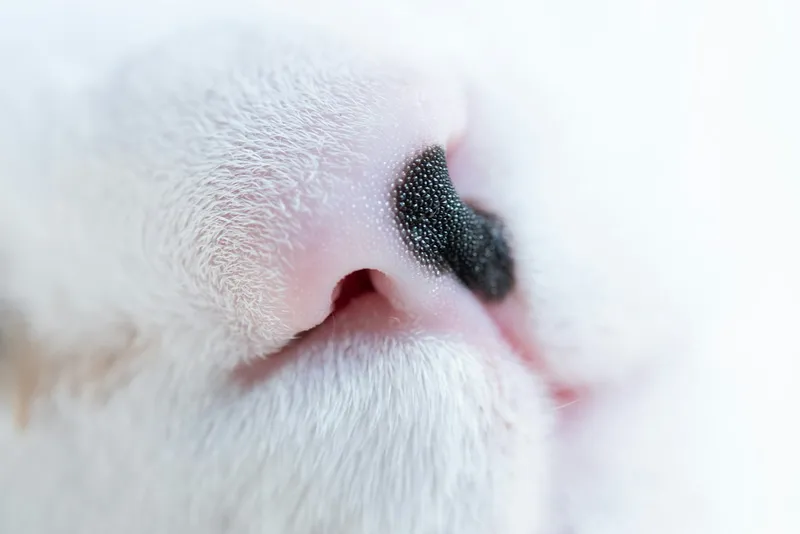
Ask what a bored cat needs and most answers involve motion: more toys, a taller tree, a wheel to run on. Almost none mention the nose, even though a cat’s sense of smell does more of its daily information-gathering than its eyes or ears. An indoor home with the same air, the same surfaces, and the same handful of scents day after day is under-stimulating in its own way. That has nothing to do with how much floor space a cat has to run around in.
Why smell is a bigger deal for cats than for us
A cat has somewhere around 200 million scent receptors, against roughly five million in a person. They also have a second scent organ, the vomeronasal organ on the roof of the mouth, which reads pheromones that a regular sniff doesn’t pick up (that open-mouthed grimace cats make, called the flehmen response, is them using it). Scent is how a cat reads territory, tracks another cat’s mood, and decides whether a new object is worth investigating at all.
A home that smells the same every day gives that entire system nothing to do. It’s the sensory equivalent of a room with the lights always on at the same brightness. Nothing is wrong, but nothing is interesting either.
What scent boredom actually looks like
It rarely looks like an obvious complaint. More often it shows up as a cat that has stopped investigating anything new, or one whose only remaining scent-driven behavior is obsessively scratching or rubbing the same one or two spots in the house. Our scratching posts roundup covers the marking side of that behavior. This guide is about giving the nose new material before it settles for scratching as the only outlet.
Catnip and silvervine: the two chemical triggers most cats respond to
Roughly two-thirds of cats respond to catnip’s active compound, nepetalactone, with rolling, rubbing, and short bursts of play before it wears off in ten to fifteen minutes. Silvervine reaches a wider share of cats, including many that don’t respond to catnip at all, and tends to produce a calmer, longer response.
Neither is a daily habit-forming substance. Rotate them: a dusting of dried catnip one week, a silvervine stick the next, so the novelty (which is most of what makes the reaction work) doesn’t wear thin from overexposure. Our catnip and silvervine roundup covers specific products if regular catnip toys have stopped getting a reaction.
Foraging for scent, not just food
A snuffle mat or a scattering of treats hidden in folded fabric turns eating into a scent-tracking task instead of a walk to a bowl. This works because it recreates something closer to a real hunt: food that has to be located by smell rather than food that’s already sitting in the open. Our snuffle and lick mat roundup has options sorted by how much setup each one needs.
Cat grass and safe herbs work on the same principle from a different angle: something growing, with its own changing scent as it’s chewed and bruised, instead of a static object. It’s a low-effort way to add a genuinely novel smell to a room that otherwise never changes.
Rotating scent without overloading a stressed cat
More isn’t automatically better here. A cat already running high on general stress can find a room saturated with new, unfamiliar odors overwhelming rather than engaging, especially right after a move or a household change. Our guide on how long settling in takes covers why timing matters as much as the enrichment itself.
The safer approach is one new scent source at a time, introduced in a space the cat already treats as safe rather than an unfamiliar room. Watch for curious sniffing and short investigation as the sign it’s landing well, and back off if the reaction looks more like avoidance than interest.
What not to use for this
Essential oils and the diffusers that disperse them are a common instinct here since this guide is about smell, and they’re the wrong tool. Cats lack a liver enzyme most mammals use to break these compounds down. Oils that are harmless to dogs or people, including tea tree, eucalyptus, citrus, and pine, can cause real toxicity in a cat from inhaling diffused air, from skin contact, or from grooming oil off their fur. Stick to catnip, silvervine, cat grass, and safe herbs for scent enrichment. Skip anything marketed as an essential oil diffuser or aromatherapy product, even ones labeled pet-safe, unless a vet has specifically cleared it.
Where this fits with everything else
Scent enrichment isn’t a replacement for physical play or foraging feeders, it’s a third channel alongside them. A cat that already gets daily wand play and a puzzle feeder still benefits from something new to smell, the same way a person with a good exercise routine still benefits from reading something they haven’t read before. None of these pillars substitute for the others; they cover different senses that all go quiet in a home that never changes.